
Tirzepatida vs Retatrutida vs Semaglutida
Las tres se estudian en señalización de incretinas y se distinguen por cuántos receptores activa cada una. La semaglutida actúa sobre uno, el de GLP-1; la tirzepatida sobre dos, GIP y GLP-1; la retatrutida sobre tres, sumando glucagón. La semaglutida es un medicamento de prescripción y no está en nuestro catálogo.
| Especificación |  Tirzepatida Tirzepatida | 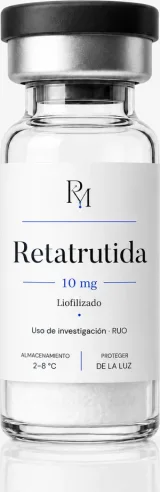 Retatrutida Retatrutida |  Semaglutida Semaglutida |
|---|---|---|---|
| Mecanismo | Agonista dual · GIP / GLP-1 | Triagonista · GIP / GLP-1 / glucagón | Agonista del receptor de GLP-1 |
| Código | LY3298176 | LY3437943 | NN9535 |
| Fórmula molecular | C225H348N48O68 | C221H342N46O68 | C187H291N45O59S |
| Masa molar | 4813.5 Da | 4731.33 Da | 4113.58 g/mol |
| Pureza | ≥99% | ≥99% | No en catálogo |
| Presentaciones | 10 mg / 20 mg / 30 mg / 60 mg | 10 mg / 15 mg / 20 mg / 30 mg / 40 mg | No en catálogo |
| Precio | desde $900MXN | desde $1,700MXN | No en catálogo |
| Área | Señalización metabólica | Señalización metabólica | Señalización metabólica |
| Evidencia | Tirzepatida | Retatrutida | Semaglutida |
|---|---|---|---|
| Estado | En catálogo (RUO) | En catálogo (RUO) | Molécula con formulaciones farmacéuticas aprobadas · material RUO disponible por volumen |
| Nivel de evidencia | A | A | A |
| Estudio clave | Coskun T (2018) | Coskun T (2022) | Moiz A (2025) |
Nivel de evidencia: A revisiones o ensayos en humanos replicados · B ensayo humano temprano · C estudios en animales · D in vitro o mecanismo. Referencias primarias indexadas en PubMed; contexto de investigación, sin implicar uso humano.
Diferencia principal entre Tirzepatida, Retatrutida y Semaglutida
Uno, dos, tres receptores. Es la forma más simple de ordenarlas: semaglutida (GLP-1), tirzepatida (GIP + GLP-1) y retatrutida (GIP + GLP-1 + glucagón). Cada receptor adicional es una vía metabólica más que la molécula activa a la vez.
Criterios de comparación de Tirzepatida, Retatrutida y Semaglutida
La tabla separa identidad molecular, mecanismo, masa molar, evidencia publicada, presentaciones y disponibilidad. Una coincidencia en el área de investigación no vuelve equivalentes dos compuestos: secuencia, receptor, modelo experimental y documentación del lote se revisan por separado.
De uno a tres receptores
La semaglutida es un agonista de GLP-1. La tirzepatida añade el receptor de GIP, una segunda vía de incretinas, en la misma molécula.
La retatrutida suma un tercer brazo, el receptor de glucagón, que se asocia al gasto energético. Cada paso amplía el número de vías que la molécula toca a la vez, y es el eje sobre el que la investigación las compara.
Disponibilidad de Tirzepatida, Retatrutida y Semaglutida
La tirzepatida y la retatrutida las ofrecemos para investigación, con pureza por HPLC e identidad por MS. La semaglutida se incluye como referencia: es de prescripción y no la vendemos.
Comparaciones disponibles: tirzepatida frente a semaglutida, retatrutida frente a semaglutida y tirzepatida frente a retatrutida.
Semaglutida no está disponible como material RUO. Tirzepatida y Retatrutida: pureza por HPLC, identidad por MS y COA por lote.
Uso exclusivo de investigación (RUO). No apto para consumo humano o animal.
Comparativas relacionadas con Tirzepatida, Retatrutida y Semaglutida
- Tirzepatida vs Retatrutida
- Tirzepatida vs Semaglutida
- Retatrutida vs Semaglutida
- Retatrutida vs Mazdutide
- Tirzepatida vs Cagrilintida
- Retatrutida vs Survodutide
- Retatrutida vs Orforglipron
- Tirzepatida vs Exenatida
Referencias de Tirzepatida, Retatrutida y Semaglutida
- Coskun T, Sloop KW, Loghin C, et al. (2018). LY3298176, a novel dual GIP and GLP-1 receptor agonist for the treatment of type 2 diabetes mellitus: From discovery to clinical proof of concept. Mol Metab. doi:10.1016/j.molmet.2018.09.009
- Sun B, Willard FS, Feng D, et al. (2022). Structural determinants of dual incretin receptor agonism by tirzepatide. Proc Natl Acad Sci U S A. doi:10.1073/pnas.2116506119
- Samms RJ, Christe ME, Collins KA, et al. (2021). GIPR agonism mediates weight-independent insulin sensitization by tirzepatide in obese mice. J Clin Invest. doi:10.1172/JCI146353
- Heise T, Mari A, DeVries JH, et al. (2022). Effects of subcutaneous tirzepatide versus placebo or semaglutide on pancreatic islet function and insulin sensitivity in adults with type 2 diabetes. Lancet Diabetes Endocrinol. doi:10.1016/S2213-8587(22)00085-7
- Willard FS, Douros JD, Gabe MBN, et al. (2020). Tirzepatide is an imbalanced and biased dual GIP and GLP-1 receptor agonist. JCI Insight. doi:10.1172/jci.insight.140532
- Rees TA, Buttle BJ, Tasma Z, et al. (2024). Tirzepatide, GIP(1-42) and GIP(1-30) display unique signaling profiles at two common GIP receptor variants, E354 and Q354. Front Pharmacol. doi:10.3389/fphar.2024.1463313
- Zou X, He Y, Gao Y, Wang J, Zhang JZH (2025). Understanding the activation mechanism of GLP-1R/GIPR by dual agonist Tirzepatide via molecular dynamics and protein-peptide binding. Int J Biol Macromol. doi:10.1016/j.ijbiomac.2025.146141
- Frías JP, Davies MJ, Rosenstock J, et al. (2021). Tirzepatide versus Semaglutide Once Weekly in Patients with Type 2 Diabetes. N Engl J Med. doi:10.1056/NEJMoa2107519
- Jastreboff AM, Aronne LJ, Ahmad NN, et al. (2022). Tirzepatide Once Weekly for the Treatment of Obesity. N Engl J Med. doi:10.1056/NEJMoa2206038
- Aronne LJ, Bade Horn D, le Roux CW, et al. (2025). Tirzepatide as Compared with Semaglutide for the Treatment of Obesity. N Engl J Med. doi:10.1056/NEJMoa2416394
- Horn DB, Linetzky B, Davies MJ, et al. (2026). Cardiometabolic Parameter Change by Weight Regain on Tirzepatide Withdrawal in Adults With Obesity: A Post Hoc Analysis of the SURMOUNT-4 Trial. JAMA Intern Med. doi:10.1001/jamainternmed.2025.6112
- Regmi A, Aihara E, Christe ME, et al. (2024). Tirzepatide modulates the regulation of adipocyte nutrient metabolism through long-acting activation of the GIP receptor. Cell Metab. doi:10.1016/j.cmet.2024.05.010
- Aronne LJ, Sattar N, Horn DB, et al. (2024). Continued Treatment With Tirzepatide for Maintenance of Weight Reduction in Adults With Obesity: The SURMOUNT-4 Randomized Clinical Trial. JAMA. doi:10.1001/jama.2023.24945
- Loomba R, Hartman ML, Lawitz EJ, et al. (2024). Tirzepatide for Metabolic Dysfunction-Associated Steatohepatitis with Liver Fibrosis. N Engl J Med. doi:10.1056/NEJMoa2401943
- Malhotra A, Grunstein RR, Fietze I, et al. (2024). Tirzepatide for the Treatment of Obstructive Sleep Apnea and Obesity. N Engl J Med. doi:10.1056/NEJMoa2404881
- Packer M, Zile MR, Kramer CM, et al. (2025). Tirzepatide for Heart Failure with Preserved Ejection Fraction and Obesity. N Engl J Med. doi:10.1056/NEJMoa2410027
- Nicholls SJ, Pavo I, Bhatt DL, et al. (2025). Cardiovascular Outcomes with Tirzepatide versus Dulaglutide in Type 2 Diabetes. N Engl J Med. doi:10.1056/NEJMoa2505928
- Look M, Dunn JP, Kushner RF, et al. (2025). Body composition changes during weight reduction with tirzepatide in the SURMOUNT-1 study of adults with obesity or overweight. Diabetes Obes Metab. doi:10.1111/dom.16275
- Horn DB, Aronne LJ, Wharton S, et al. (2026). Tirzepatide for maintenance of bodyweight reduction in people with obesity in the USA (SURMOUNT-MAINTAIN): a multicentre, double-blind, randomised, placebo-controlled trial. Lancet. doi:10.1016/S0140-6736(26)00656-2
- Pratley RE, Denham DS, Trivedi R, et al. (2026). Apitegromab for lean mass preservation during tirzepatide-induced weight loss: a randomized, double-blind, placebo-controlled phase 2 trial. Nat Med. doi:10.1038/s41591-026-04440-4
- Coskun T, Sloop KW, Loghin C, et al. (2022). LY3437943, a novel triple GIP, GLP-1, and glucagon receptor agonist for glycemic control and weight loss: From discovery to clinical proof of concept. Cell Metab. doi:10.1016/j.cmet.2022.07.013
- Jastreboff AM, Kaplan LM, Frías JP, et al. (2023). Triple-Hormone-Receptor Agonist Retatrutide for Obesity — A Phase 2 Trial. N Engl J Med. doi:10.1056/NEJMoa2301972
- Rosenstock J, Frias J, Jastreboff AM, et al. (2023). Retatrutide, a GIP, GLP-1 and glucagon receptor agonist, for people with type 2 diabetes: a randomised, double-blind, placebo and active-controlled, parallel-group, phase 2 trial. Lancet. doi:10.1016/S0140-6736(23)01053-X
- Urva S, Coskun T, Loh MT, et al. (2022). LY3437943, a novel triple GIP, GLP-1, and glucagon receptor agonist in people with type 2 diabetes: a phase 1b, multiple-ascending dose trial. Lancet. doi:10.1016/S0140-6736(22)02033-5
- Pearson MJ, Willency JA, Lin Y, et al. (2026). Retatrutide and lipid and metabolite profiles in participants with obesity with or without type 2 diabetes. J Clin Endocrinol Metab. doi:10.1210/clinem/dgag201
- Sanyal AJ, Kaplan LM, Frias JP, et al. (2024). Triple hormone receptor agonist retatrutide for metabolic dysfunction-associated steatotic liver disease: a randomized phase 2a trial. Nat Med. doi:10.1038/s41591-024-03018-2
- Coskun T, Wu Q, Schloot NC, et al. (2025). Effects of retatrutide on body composition in people with type 2 diabetes: a substudy of a phase 2 randomised trial. Lancet Diabetes Endocrinol. doi:10.1016/S2213-8587(25)00092-0
- Wen Y, Lemen D, Lin Y, et al. (2025). Decreases in circulating ANGPTL3/8 concentrations following retatrutide treatment parallel reductions in serum lipids. Diabetes Obes Metab. doi:10.1111/dom.16661
- Li W, Zhou Q, Cong Z, et al. (2024). Structural insights into the triple agonism at GLP-1R, GIPR and GCGR manifested by retatrutide. Cell Discov. doi:10.1038/s41421-024-00700-0
- Bajaj HS, Welch M, Shah P, et al. (2026). Efficacy and safety of retatrutide, a GIP, GLP-1, and glucagon receptor agonist, in people with type 2 diabetes and inadequate glycaemic control with diet and exercise (TRANSCEND-T2D-1): a double-blind, randomised, phase 3 trial. Lancet. doi:10.1016/S0140-6736(26)00967-0
- Moiz A, Filion KB, Tsoukas MA, et al. (2025). Mechanisms of GLP-1 Receptor Agonist-Induced Weight Loss: A Review of Central and Peripheral Pathways in Appetite and Energy Regulation. Am J Med. doi:10.1016/j.amjmed.2025.01.021
- Chao AM, Tronieri JS, Amaro A, Wadden TA (2021). Semaglutide for the treatment of obesity. Trends Cardiovasc Med. doi:10.1016/j.tcm.2021.12.008
Literatura primaria indexada en PubMed. Referencias de contexto de investigación; no implican uso clínico ni humano.