
TB-500 vs GHK-Cu
Los dos se estudian en reparación de tejido, pero sobre estructuras distintas. TB-500 corresponde a timosina β4 sintética de 43 aminoácidos y se investiga sobre dinámica de actina y migración celular. GHK-Cu es un tripéptido que fija cobre(II) y se estudia sobre matriz extracelular.
| Especificación | 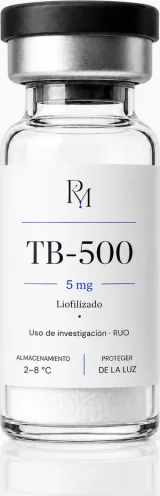 TB-500 TB-500 | 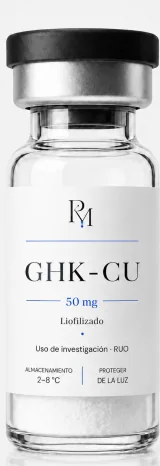 GHK-Cu GHK-Cu |
|---|---|---|
| Mecanismo | Timosina β4 sintética · actina | Tripéptido de cobre |
| Código | — | — |
| Fórmula molecular | C212H350N56O78S | C14H21CuN6O4 |
| Masa molar | 4963.44 Da | 404.9 Da |
| Pureza | ≥99% | ≥99% |
| Presentaciones | 5 mg | 50 mg / 100 mg |
| Precio | desde $850MXN | desde $499MXN |
| Área | Regeneración de tejido | Matriz extracelular |
| Evidencia | TB-500 | GHK-Cu |
|---|---|---|
| Estado | En catálogo (RUO) | En catálogo (RUO) |
| Nivel de evidencia | B | C |
| Estudio clave | Heintz D (1994) | Freedman JH (1982) |
Nivel de evidencia: A revisiones o ensayos en humanos replicados · B ensayo humano temprano · C estudios en animales · D in vitro o mecanismo. Referencias primarias indexadas en PubMed; contexto de investigación, sin implicar uso humano.
Diferencia principal entre TB-500 y GHK-Cu
TB-500 se estudia sobre el citoesqueleto y la migración celular. GHK-Cu se estudia sobre la matriz extracelular y el transporte de cobre. No comparten diana.
Criterios de comparación de TB-500 y GHK-Cu
La tabla separa identidad molecular, mecanismo, masa molar, evidencia publicada, presentaciones y disponibilidad. Una coincidencia en el área de investigación no vuelve equivalentes dos compuestos: secuencia, receptor, modelo experimental y documentación del lote se revisan por separado.
Origen molecular de TB-500 y GHK-Cu
La presentación declarada como TB-500 corresponde a timosina β4 sintética de 43 aminoácidos. El mercado también utiliza ese nombre para el fragmento 17–23; su secuencia y masa no son equivalentes.
El GHK-Cu es el tripéptido glicil-L-histidil-L-lisina unido a cobre(II). La secuencia GHK se aisló del plasma humano y se estudia como modelo de coordinación y transporte de cobre.
Modelos experimentales de TB-500 y GHK-Cu
El TB-500 se estudia en sistemas celulares y animales con foco en movilización de células, actina y formación de vasos.
El GHK-Cu se estudia en expresión de componentes de matriz y coordinación de cobre. Los datos citados corresponden a modelos experimentales, no a resultados de uso humano.
Uso exclusivo de investigación (RUO). No apto para consumo humano o animal.
Comparativas relacionadas con TB-500 y GHK-Cu
Referencias de TB-500 y GHK-Cu
- Heintz D, Reichert A, Mihelic-Rapp M, et al. (1994). The sulfoxide of thymosin beta 4 almost lacks the polymerization-inhibiting capacity for actin. Eur J Biochem. doi:10.1111/j.1432-1033.1994.tb19000.x
- Safer D, Sosnick TR, Elzinga M (1997). Thymosin beta 4 binds actin in an extended conformation and contacts both the barbed and pointed ends. Biochemistry. doi:10.1021/bi970185v
- Malinda KM, Goldstein AL, Kleinman HK (1997). Thymosin beta 4 stimulates directional migration of human umbilical vein endothelial cells. FASEB J. doi:10.1096/fasebj.11.6.9194528
- Ho ENM, Kwok WH, Lau MY, et al. (2012). Doping control analysis of TB-500, a synthetic version of an active region of thymosin β4, in equine urine and plasma by liquid chromatography-mass spectrometry. J Chromatogr A. doi:10.1016/j.chroma.2012.09.043
- Goldstein AL, Hannappel E, Sosne G, Kleinman HK (2012). Thymosin β4: a multi-functional regenerative peptide. Basic properties and clinical applications. Expert Opin Biol Ther. doi:10.1517/14712598.2012.634793
- Gao YX, Wang LF, Ba SJ, et al. (2022). Research advances on thymosin β4 in promoting wound healing. Zhonghua Shao Shang Yu Chuang Mian Xiu Fu Za Zhi. doi:10.3760/cma.j.cn501120-20210221-00059
- Zhang X, Lin Y, Li H, Wang Q, Mu D (2025). Enhancing fat graft survival: thymosin beta-4 facilitates mitochondrial transfer from ADSCs via tunneling nanotubes by upregulating the Rac/F-actin pathway. Free Radic Biol Med. doi:10.1016/j.freeradbiomed.2024.12.061
- Zeng PM, Sun XY, Li Y, et al. (2025). Thymosin beta 4 as an Alzheimer disease intervention target identified using human brain organoids. Stem Cell Reports. doi:10.1016/j.stemcr.2025.102601
- Freedman JH, Pickart L, Weinstein B, Mims WB, Peisach J (1982). Structure of the Glycyl-L-histidyl-L-lysine—copper(II) complex in solution. Biochemistry. doi:10.1021/bi00262a004
- Maquart FX, Pickart L, Laurent M, Gillery P, Monboisse JC, Borel JP (1988). Stimulation of collagen synthesis in fibroblast cultures by the tripeptide-copper complex glycyl-L-histidyl-L-lysine-Cu2+. FEBS Lett. doi:10.1016/0014-5793(88)80509-X
- Siméon A, Emonard H, Hornebeck W, Maquart FX (2000). The tripeptide-copper complex glycyl-L-histidyl-L-lysine-Cu2+ stimulates matrix metalloproteinase-2 expression by fibroblast cultures. Life Sci. doi:10.1016/S0024-3205(00)00803-1
- Min JH, Sarlus H, Harris RA (2024). Glycyl-L-histidyl-L-lysine prevents copper- and zinc-induced protein aggregation and central nervous system cell death in vitro. Metallomics. doi:10.1093/mtomcs/mfae019
- Jiang F, Wu Y, Liu Z, Hong M, Huang Y (2023). Synergy of GHK-Cu and hyaluronic acid on collagen IV upregulation via fibroblast and ex-vivo skin tests. J Cosmet Dermatol. doi:10.1111/jocd.15763
- Zhang Q, Liu J, Deng MM, Tong R, Hou G (2023). Relief of ovalbumin-induced airway remodeling by the glycyl-L-histidyl-L-lysine-Cu(2+) tripeptide complex via activation of SIRT1 in airway epithelial cells. Biomed Pharmacother. doi:10.1016/j.biopha.2023.114936
- Mehr A, Henneberg F, Chari A, Görlich D (2020). The copper(II)-binding tripeptide GHK, a valuable crystallization and phasing tag for macromolecular crystallography. Acta Crystallogr D Struct Biol. doi:10.1107/S2059798320013741
- Bian Y, Deng M, Liu J, et al. (2024). The glycyl-L-histidyl-L-lysine-Cu2+ tripeptide complex attenuates lung inflammation and fibrosis in silicosis by targeting peroxiredoxin 6. Redox Biol. doi:10.1016/j.redox.2024.103237
- Mao S, Huang J, Li J, et al. (2025). Exploring the beneficial effects of GHK-Cu on an experimental model of colitis and the underlying mechanisms. Front Pharmacol. doi:10.3389/fphar.2025.1551843
Literatura primaria indexada en PubMed. Referencias de contexto de investigación; no implican uso clínico ni humano.