
BPC-157 vs TB-500
Los dos aparecen en modelos de angiogénesis y migración celular, pero por vías distintas. El BPC-157 es un pentadecapéptido derivado de una proteína gástrica; TB-500 corresponde a timosina β4 sintética de 43 aminoácidos, ligada a la regulación de la actina.
| Especificación | 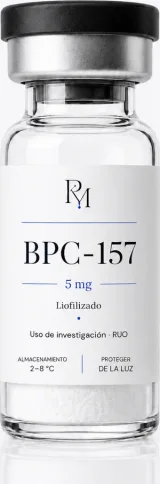 BPC-157 BPC-157 | 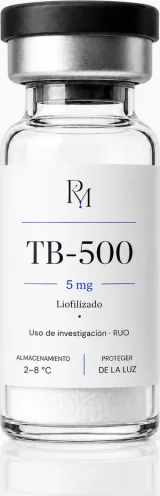 TB-500 TB-500 |
|---|---|---|
| Mecanismo | Péptido gástrico estable | Timosina β4 sintética · actina |
| Código | — | — |
| Fórmula molecular | C62H98N16O22 | C212H350N56O78S |
| Masa molar | 1419.55 Da | 4963.44 Da |
| Pureza | ≥99% | ≥99% |
| Presentaciones | 5 mg | 5 mg |
| Precio | desde $580MXN | desde $850MXN |
| Área | Regeneración de tejido | Regeneración de tejido |
| Evidencia | BPC-157 | TB-500 |
|---|---|---|
| Estado | En catálogo (RUO) | En catálogo (RUO) |
| Nivel de evidencia | C | B |
| Estudio clave | Chang CH (2011) | Heintz D (1994) |
Nivel de evidencia: A revisiones o ensayos en humanos replicados · B ensayo humano temprano · C estudios en animales · D in vitro o mecanismo. Referencias primarias indexadas en PubMed; contexto de investigación, sin implicar uso humano.
Diferencia principal entre BPC-157 y TB-500
El mecanismo los separa: BPC-157 se investiga sobre señalización angiogénica y TB-500 sobre dinámica de actina y movilidad celular. Son preguntas experimentales distintas.
Criterios de comparación de BPC-157 y TB-500
La tabla separa identidad molecular, mecanismo, masa molar, evidencia publicada, presentaciones y disponibilidad. Una coincidencia en el área de investigación no vuelve equivalentes dos compuestos: secuencia, receptor, modelo experimental y documentación del lote se revisan por separado.
Uso exclusivo de investigación (RUO). No apto para consumo humano o animal.
Comparativas relacionadas con BPC-157 y TB-500
Referencias de BPC-157 y TB-500
- Chang CH, Tsai WC, Lin MS, Hsu YH, Pang JH (2011). The promoting effect of pentadecapeptide BPC 157 on tendon healing involves tendon outgrowth, cell survival, and cell migration. J Appl Physiol. doi:10.1152/japplphysiol.00945.2010
- Hsieh MJ, Liu HT, Wang CN, et al. (2017). Therapeutic potential of pro-angiogenic BPC157 is associated with VEGFR2 activation and up-regulation. J Mol Med (Berl). doi:10.1007/s00109-016-1488-y
- Seiwerth S, Milavic M, Vukojevic J, et al. (2021). Stable Gastric Pentadecapeptide BPC 157 and Wound Healing. Front Pharmacol. doi:10.3389/fphar.2021.627533
- Bajramagic S, Sever M, Rasic F, et al. (2024). Stable Gastric Pentadecapeptide BPC 157 and Intestinal Anastomoses Therapy in Rats — A Review. Pharmaceuticals (Basel). doi:10.3390/ph17081081
- Matek D, Matek I, Staresinic E, et al. (2025). Stable Gastric Pentadecapeptide BPC 157 as Therapy After Surgical Detachment of the Quadriceps Muscle from Its Attachments for Muscle-to-Bone Reattachment in Rats. Pharmaceutics. doi:10.3390/pharmaceutics17010119
- He Y, Jin Y, Wang X, et al. (2022). Pharmacokinetics, distribution, metabolism, and excretion of body-protective compound 157, a potential drug for treating various wounds, in rats and dogs. Front Pharmacol. doi:10.3389/fphar.2022.1026182
- Demirtaş H, Özer A, Yıldırım AK, et al. (2025). Protective Effects of BPC 157 on Liver, Kidney, and Lung Distant Organ Damage in Rats with Experimental Lower-Extremity Ischemia-Reperfusion Injury. Medicina (Kaunas). doi:10.3390/medicina61020291
- Heintz D, Reichert A, Mihelic-Rapp M, et al. (1994). The sulfoxide of thymosin beta 4 almost lacks the polymerization-inhibiting capacity for actin. Eur J Biochem. doi:10.1111/j.1432-1033.1994.tb19000.x
- Safer D, Sosnick TR, Elzinga M (1997). Thymosin beta 4 binds actin in an extended conformation and contacts both the barbed and pointed ends. Biochemistry. doi:10.1021/bi970185v
- Malinda KM, Goldstein AL, Kleinman HK (1997). Thymosin beta 4 stimulates directional migration of human umbilical vein endothelial cells. FASEB J. doi:10.1096/fasebj.11.6.9194528
- Ho ENM, Kwok WH, Lau MY, et al. (2012). Doping control analysis of TB-500, a synthetic version of an active region of thymosin β4, in equine urine and plasma by liquid chromatography-mass spectrometry. J Chromatogr A. doi:10.1016/j.chroma.2012.09.043
- Goldstein AL, Hannappel E, Sosne G, Kleinman HK (2012). Thymosin β4: a multi-functional regenerative peptide. Basic properties and clinical applications. Expert Opin Biol Ther. doi:10.1517/14712598.2012.634793
- Gao YX, Wang LF, Ba SJ, et al. (2022). Research advances on thymosin β4 in promoting wound healing. Zhonghua Shao Shang Yu Chuang Mian Xiu Fu Za Zhi. doi:10.3760/cma.j.cn501120-20210221-00059
- Zhang X, Lin Y, Li H, Wang Q, Mu D (2025). Enhancing fat graft survival: thymosin beta-4 facilitates mitochondrial transfer from ADSCs via tunneling nanotubes by upregulating the Rac/F-actin pathway. Free Radic Biol Med. doi:10.1016/j.freeradbiomed.2024.12.061
- Zeng PM, Sun XY, Li Y, et al. (2025). Thymosin beta 4 as an Alzheimer disease intervention target identified using human brain organoids. Stem Cell Reports. doi:10.1016/j.stemcr.2025.102601
Literatura primaria indexada en PubMed. Referencias de contexto de investigación; no implican uso clínico ni humano.